









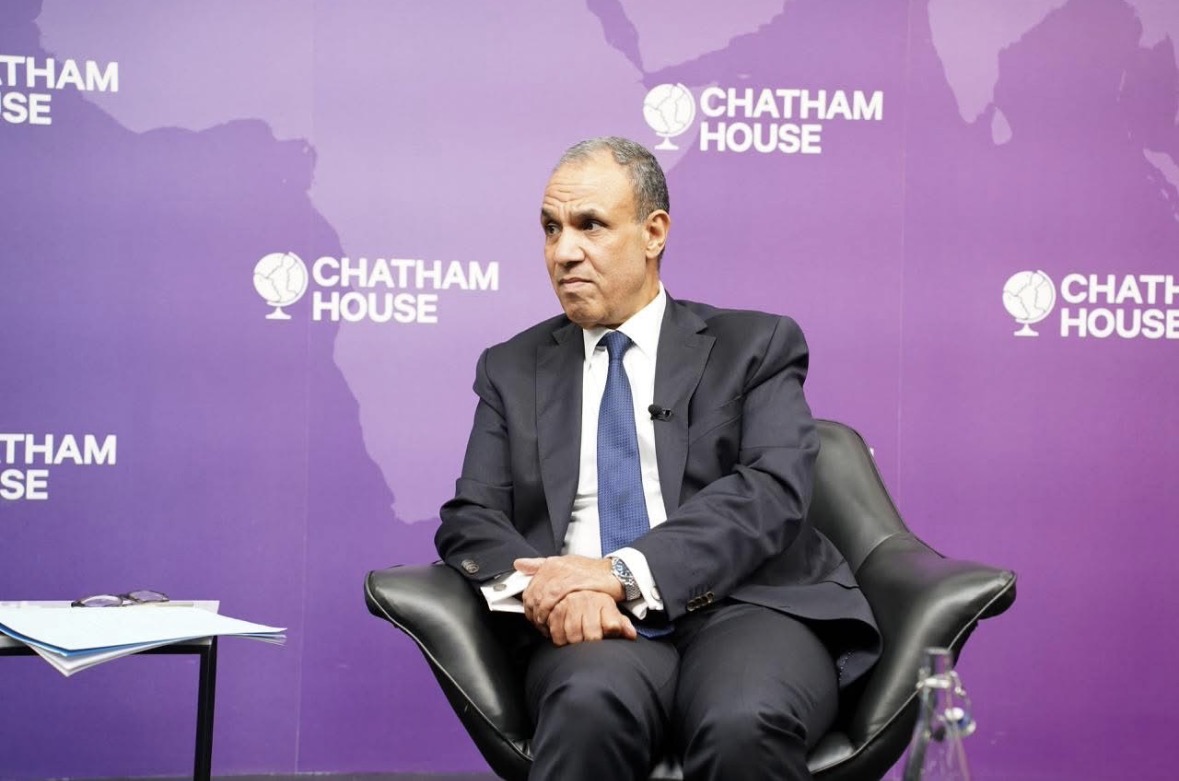
21 May Foreign Minister Stresses Importance of Diplomatic Solutions to Achieve Security and Stability in the Middle East During Chatham House Session
Dr. Badr Abdelatty, Minister of Foreign Affairs, International Cooperation, and Egyptians Abroad, participated on Wednesday, 20 May, in a discussion session at Chatham House, in London, as part of his visit to the UK. During the session, he outlined Egypt’s vision regarding the rapidly evolving developments in the Middle East and the current regional and international challenges.
Minister Abdelatty noted during the session that the Middle East is going through a critical phase marked by intertwined challenges and unprecedented tensions. He stressed that military solutions will neither achieve security nor stability, but rather deepen crises and prolong conflicts in the region. He highlighted the dangers of regional escalation and its repercussions on international peace and stability, including its impact on freedom of international navigation, energy markets, and global supply chains. He emphasized the need for concerted efforts to de-escalate tensions and prioritize dialogue and diplomatic solutions as the only path toward sustainable security, while also reviewing Egypt’s intensive efforts in this regard with regional and international partners to support the U.S.-Iranian negotiation track.
The Minister also reaffirmed Egypt’s complete rejection of any violations affecting the sovereignty of Arab states or threatening their stability, stressing Egypt’s commitment to supporting efforts aimed at containing regional tensions in coordination with a number of regional and international partners. In this context, he referred to the visits undertaken by President Abdel Fattah El-Sisi to Gulf countries, which reflected Egypt’s keenness to strengthen coordination and consultation with fellow Arab states regarding current regional challenges and to affirm that Gulf security is an integral part of Egypt’s national security.
Minister Abdelatty further stressed that the Palestinian issues will remain at the core of stability in the Middle East, reiterating Egypt’s steadfast position in support of the establishment of an independent Palestinian state along the 4 June 1967 borders, with East Jerusalem as its capital, as the only path toward achieving a just and lasting peace in the region. He also reviewed Egypt’s efforts and guiding principles regarding various regional files, including the situations in Sudan, Libya, Yemen, and Lebanon, emphasizing the importance of preserving national state institutions and supporting comprehensive political solutions.
The Foreign Minister also pointed out that achieving security and stability is not limited to political and security dimensions alone, but is also linked to supporting economic development and enhancing regional cooperation. He affirmed that Egypt continues to play its role in supporting stability and development in the region and across the African continent, reiterating Egypt’s commitment to continue working with various regional and international partners to enhance security and stability and achieve sustainable development, thereby contributing to building a safer and more prosperous future for the peoples of the region.

No Comments